

Is the business changing faster than the plan?
Some stages of the journey the business goes on can be more challenging than others. Growth is flatter and the approach that built the business isn't producing what it used to. An acquisition has happened and the logic of the new portfolio hasn't been worked through. A founder is stepping back and too much of the strategy still lives in their head. The next round of investment is on the horizon. Or the category is changing in ways the current business isn't built for. Maybe the business is doing perfectly well. But someone in the leadership team can see that a different version of the business is possible and that getting there will require more than another year of doing things the way they've always been done. These moments have something in common. The business needs to decide what it is becoming while continuing to run the business it is today. That means deciding what to carry forward, what to change and what to leave behind. And it usually takes longer than a strategy project. That's where we come in.
Use us if
Growth has outpaced the strategic approach that got you here.
A recent acquisition has reshaped the portfolio and the logic of the new whole hasn't been worked through.
A founder is stepping back and too much of the strategy still lives in their head.
An investment round is six to twelve months away and the strategic plan isn't yet tight enough.
The category is changing and the business model is starting to look like the wrong shape for where the market is going.
The business is doing well, but someone in the leadership team can see a more interesting version of it and needs help building the case for change.
What we do
A transition is not a single decision. It's a period in which the business is moving from one shape to another while still having to operate.
Sometimes the change is forced: an acquisition, leadership change, flatlining performance or a strategic reset the business didn't ask for.
The job is to make sense of what has happened, decide what needs to change, and create enough space for the leadership team to make those decisions while the rest of the business keeps moving.
Sometimes the change is chosen. The business is working well, but someone can see that it could become something different. The challenge is finding the confidence and evidence to act before circumstances make the decision for you.
In both cases, we work alongside the leadership team over the period of change. Not to produce a strategy and disappear, but to help make the decisions that keep the transition moving.
Our perspective
Most brand strategy is about strengthening what already exists.
Transitions are different. The brand needs to become something different from what it is today, while still remaining recognisable as itself.
That creates a simple but difficult question:
What needs to stay, and what needs to change?
You can't answer one without the other.
And the change isn't just about the brand. Customers, employees, partners, investors and other stakeholders all have their own understanding of what the business is. If that understanding doesn't move with the business, the transition becomes harder.
A successful transition isn't just about changing the brand. It's about helping the people around the business understand what is changing, why it’s changing, and what it means for them.
Making the change deliverable
Transitions test what a business can actually sustain. It's easy to design the business you want to become. It's harder to work out how to get there while still running the business you have. We work with the capabilities, resources and pace of the business, identifying what needs to happen now, what can happen later and what needs to be built along the way. The aim is ambitious change that the business can deliver.
The questions we ask
What is actually changing, and why?
What needs to stay for the brand to remain recognisable, and what needs to change?
Who will be affected by the change, and how will it look different from their perspective?
What can the business genuinely sustain while it is going through the transition?
Where are the biggest sources of inertia? What is keeping the current model in place?
What needs to happen first, and what can wait?
How will we know the transition has worked?
How it works
Transitions vary. Some businesses are approaching a specific moment and need to decide what happens next. Others are already in the middle of a major change. Some are doing well but know that the business needs to evolve. We work differently depending on where you are and what needs to change.
Kickstart
A focused way to understand the transition you're facing and decide what needs attention first.
One to two weeks of focused research into the business, the change it is facing and the people affected by it
A one-day workshop with the leadership team
A strategy document setting out our reading of the situation, the key decisions and what could come next
A follow-up conversation to test and refine the thinking
Typical timescale: 3-4 weeks.
Level 1 - Strategic direction
A focused piece of work to establish where the business and brand need to go next.
Conversations with the leadership team to understand the transition and what is driving it
Analysis of the current brand and the circumstances it is moving into
Assessment of the people and groups affected by the change
Assessment of current capabilities, resources and readiness
Development of a clear strategic direction: what stays, what changes and what needs to happen
Written strategy with a clear position, rationale and recommended next steps
Typical timescale: 6-8 weeks.
Level 2 - Transition strategy and articulation
A more substantial programme taking the strategic direction through to how the brand and business need to act during and after the change.
Cultural and strategic analysis of the transition
Primary research with key stakeholders where useful
Positioning and proposition development
Identification of the people and relationships that need to move with the business
Messaging for different stakeholder groups
A phased plan for the transition
A documented strategy to guide organisational, commercial and communications activity
Typical timescale: 3-4 months.
Level 3 - Sustained partnership through change
Ongoing strategic support for businesses going through an extended period of change.
Strategic support as important decisions arise
Regular assessment of how the transition is developing
Support with the relationships and stakeholders affected by the change
Annual review of the transition and the brand's positioning
Ongoing analysis of changes in the category and wider culture
Typical timescale: annual partnership, usually starting with a twelve-month engagement.
Bespoke engagements
Not every transition fits neatly into a package.
We can also work on specific situations such as:
Post-acquisition brand integration, where two businesses or brands need to become one
Founder exit and succession, where the brand needs to evolve beyond its founding identity
Unexpected change, such as a leadership departure, category disruption or reputational event
Preparing a business or brand for sale
We shape the project around the decision the business needs to make.
What we bring
25 years of brand strategy and senior leadership experience, including MD-level roles in growth businesses. Experience working with leadership teams when the business is changing, not just when the strategy is being written. And the willingness to stay close to the business as the transition unfolds, rather than dropping in to produce a strategy and disappearing again.
Free transition guide
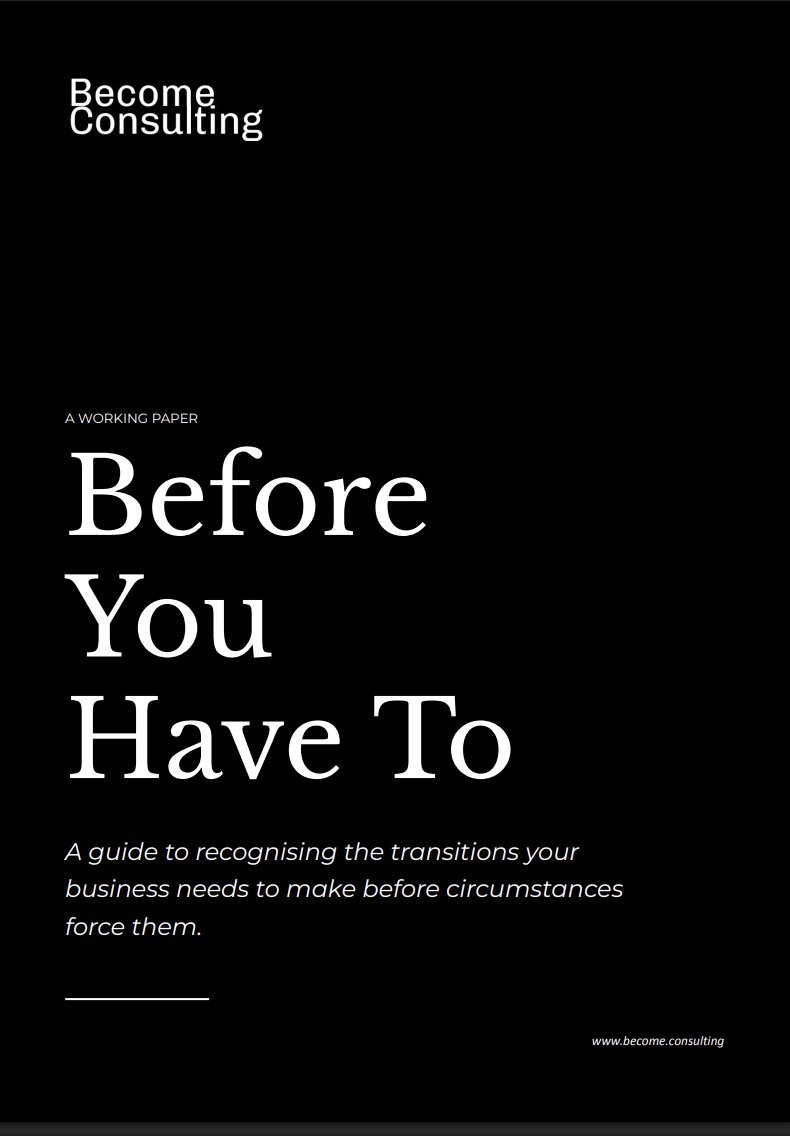
Get our working paper exploring how businesses can recognise the transitions they need to make before circumstances force them.
Only 12% of business transformations achieve their original ambition, according to a 2024 Bain study. But there's another problem that is harder to measure: the changes that businesses know they need to make but never get around to making.
Before you have to looks at both.
Inside:
A short diagnostic to help you understand where your business is: forced transition, chosen transition, or neither
A way to handle the first 90 days of a forced transition
A method for building the internal case for a chosen transition
A framework for identifying strategic inertia
Reflections drawing on the work of Donald Sull and Marshall Goldsmith