

For founders working out where the business goes next
Most startups don't fail because their product is wrong. They fail because they run out of time before they work out which version of the product is right.
The early years of a business are a period of searching: for the right customer, the right proposition and the right business model. And all of that happens under real time pressure and limited resources.
Marketing works differently at this stage. The brief that would normally guide it doesn't yet exist, because the proposition it would describe hasn't been settled.
We've spent a long time working with businesses at this stage. Our view is that marketing isn't something to bolt on once the model is clear. It's part of how the model becomes clear.
Use us if
You're a founder or small leadership team trying to work out what your proposition should be, who you're really for, and how the two connect.
You're between funding rounds and need to use the next twelve months to validate things that aren't yet validated.
You've launched and have early traction but no clear sense of what's working, why it's working, or where to invest next.
You're shaping a product and user research could make it work better.
You're considering hiring your first marketing lead and want help shaping the role, the brief and the early priorities before you commit.
You've reached a point where instinct alone isn't enough to make the next set of decisions.
What we do
The work depends on where the business is. Sometimes it's foundational: working out the proposition, understanding the customer, defining the brand and establishing how marketing and product should work together. Sometimes it's diagnostic: understanding what's been tried, what's working, what's not and where the real opportunity lies. Sometimes it's research: getting closer to customers or testing a proposition when an important decision depends on better evidence. And sometimes it's structural: helping shape the first marketing role, the brief for a new hire, or the relationship between founders, marketing and product. Across all of this, we balance two things that are often treated as opposites: building momentum now and building something that will still work as the business grows. Short-term thinking can burn through the budget without building anything lasting. Long-term thinking can produce a strategy the business never has time to execute. The important thing is to do both at once. We work as an outside perspective rather than a one-off consultant. Close enough to understand what's actually happening, but removed enough to see what can be difficult to see from inside.
How it works
Most projects start with a short diagnostic phase: conversations with the founders, a look at existing materials and data, and a working view of where the business is and what the most useful next moves might be. From there, the shape of the work is flexible. It might be a focused six to twelve week project to help make a specific decision. It might be an ongoing partnership, providing senior marketing leadership and strategic support when you’re not ready for (or can’t find) a full-time Marketing Director. Or something in between. We shape the work around the decisions the business needs to make, rather than fitting it into a standard package.
What we bring
25 years of brand strategy experience, including senior leadership roles in growth businesses and direct work with early-stage founders. The ability to think across product, brand, audience and category at the same time. And a willingness to engage with the actual decisions in front of you, rather than working at the level of a recommendation deck.
Free start up guide
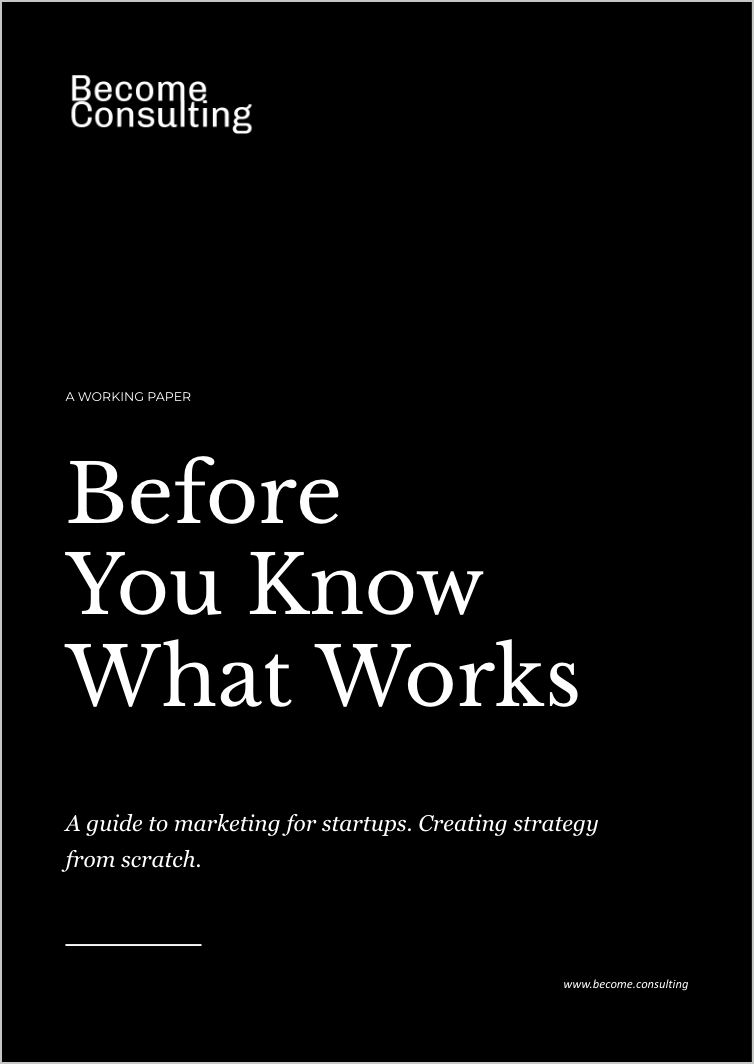
Get our working paper on marketing for startups. Written for the period when the product, the customer, and the business model are all still being discovered.
Most startups aren't failing because their marketing is bad. They're failing because they're trying to do established business marketing on a business that hasn't yet figured out what it is.
Steve Blank defined a startup as a temporary organisation designed to search for a repeatable and scalable business model.
Two words there are important. Temporary: because a startup either finds its model and becomes a different kind of business, or it doesn't. Searching: because, unlike established businesses a startup is looking for its model rather than executing one. Marketing's role in that search is fundamentally different from its role afterwards.
Our 'Before you know what works' working paper is about how marketing needs to function in that early, uncertain phase. And how to build a marketing capability that develops alongside the business, rather than treating marketing as something to bolt on once the model is clear.
Inside:
A framework for adapting marketing to each of the five stages of startup growth
The case for treating marketing and product development as one practice, not two
A method for finding a niche before trying to find a market
A working argument for balancing growth hacking with growth nurturing
Reflections drawing on Steve Blank, Eric Ries, April Dunford and Bob Moesta